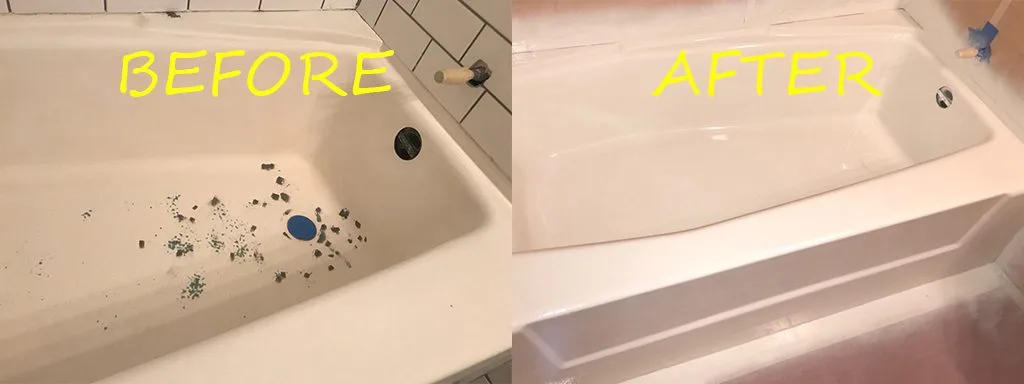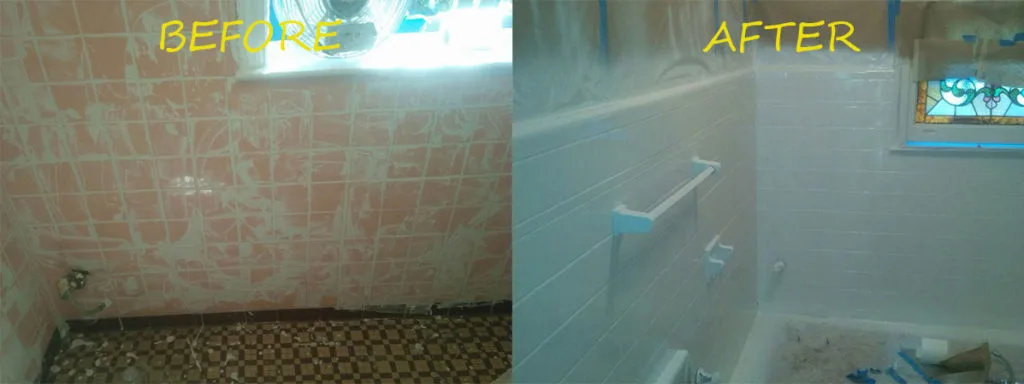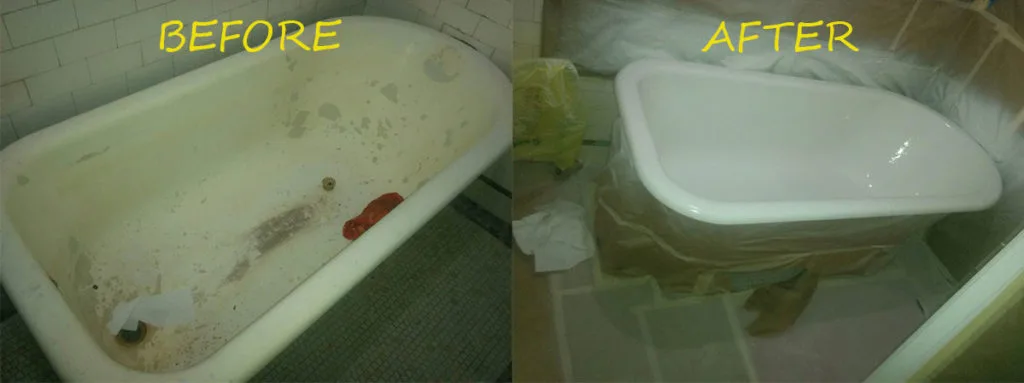

If the coating on your reglazed tub has blistered, started to feel soft underfoot or is coming off in pieces, it has lost its bond with the tub. The only reliable fix is to take the failed layer off down to sound material, prepare the surface again and recoat it. Local patches and touch-ups will not help here: water is already getting under the loose coating, and mold and corrosion grow there fast.
Why a reglazed tub peels
The material itself is almost never to blame. A tub coating needs strict adherence to the process. As it cures, it shrinks very slightly and pulls toward the center. If the coating has nothing to grip on the tub surface, sooner or later it lets go in a single sheet. Peeling is a prep failure, not a failure of the method. Most cases of blistering and peeling come down to a few ordinary causes.
The etch or sanding was skipped
The factory gloss of an old tub is smooth as a mirror. A new coating will not hold on to it. The surface has to be etched or sanded until it is fully matte and rough, so the coating has something to bond to. If the tub was only lightly rubbed with ordinary store sandpaper, expect bubbles.
Moisture under the coating
The surface of an old tub only looks solid. In reality the enamel is covered with a network of fine cracks. If the tub is not dried thoroughly after washing, moisture stays in those pores. The coating sprayed on top seals it in. Once you run a hot bath, that moisture starts to evaporate hard, and the vapor pressure literally tears the coating off the base.
A thinned or cheap mix
Good coating material is thick, and working with it takes skill. Because of that, some people thin it with ordinary solvent so it goes on easier. Too much solvent disrupts the curing chemistry. The coating loses strength, turns brittle, quickly gets a web of cracks and starts to flake.
How the tub was used afterwards
A coating also fails because of what happens to it later. Water standing at the drain, using the tub too early, harsh household chemicals, chips that were left open and overheating all show up again and again as the reason an old coating gave out. Suction-cup bath mats belong on this list too: they hold water against the surface and pull at it every time they are lifted. Abrasive powders and strong bleach-based gel cleaners leave countless fine scratches on the gloss; for what is safe to use, see the right way to clean a reglazed surface.
A paint-over or a kit job
If the tub was simply brushed with paint, or done from a kit, the work cannot be treated as a normal reglaze. A brushed or rolled layer laid over glossy, damp or greasy enamel is exactly the case where the new material looks fine on day one and then lifts. The trade-offs are covered in DIY reglazing kits versus hiring a pro. If you are wondering whether the failure is simply age, our guide on how long a reglazed tub really lasts covers that.
Spot peeling vs widespread peeling
There are four conditions that should not be mixed up. The first is ordinary wear: the surface has lost its shine, turned rough or picked up fine scratches, but it is not separating from the base. The second is a local defect: a chip, a crack in the coating or a small blister. The third is a systemic loss of bond, when the material comes away in several places or in sheets. The fourth concerns the tub itself: rust through, deformation, movement or damage to the structure.
These cases need different amounts of prep. A worn but well-bonded layer is judged differently from a soft or peeling one. One loose edge does not prove the coating is weak everywhere, but a neat-looking center does not guarantee it holds at the drain and along the rim either. From a single photo you can tell the type of visible defect, but you cannot reliably tell how far it continues under the intact surface. Sometimes the edges only show up during prep. Small chips and cracks are their own subject: see how to fix cracks and chips before reglazing.
Things to check:
- what the tub is made of and what the old coating was;
- the edges at the drain, the overflow and the rim;
- scratches and buildup, kept apart from blisters and peeling;
- rust, cracks, movement and deformation;
- which layer will remain as a reliable base.
Why patching rarely holds
If the material comes off in a sheet, blisters in different places or sits on weak paint, covering only the visible area is not enough. The new layer would rest on something that has already lost its bond. Where removal stops is decided not by how neat the edge looks but by where the sound base begins. Prep ends where the surface has become clean, dry and stable.
The worst outcome is a good-looking coating laid over a weak base. At first everything looks fine. Then a blister appears, an edge starts lifting, rust shows through near the drain, or the material scratches faster than it should. Most often the reason is not one move by the installer but a chain: the old layer was not noticed, the weak spot was not removed, the problem area was not dried, the tub was used too soon.
The drain area is another common point. The owner sees a stain and thinks it will simply be covered. It needs a closer look: is there rust, is the metal holding, is the old drain leaking, can the edge be prepared properly. Sometimes it is better to replace the drain before refinishing than to disturb the fresh surface later.
Do not try to trim a loose edge yourself, rub a spot with abrasive or run silicone over a problem you do not understand. That often makes it worse.

How a failed coat is redone
Redoing someone else's mistakes usually takes longer and is harder than coating a tub from scratch. When we redo a failed coat, the order is fixed: strip the old coating, sand down to sound material, repair, prime, spray, and leave it for a full cure. Bare metal and rust are dealt with once the old layer is off, then the tub is washed, degreased and dried through before anything new goes on. Only when the surface is clean, dry and matte can the new coat start. The steps are described on our bathtub reglazing service page.
Do not try to strip the coating yourself with a store-bought stripper: it can leave a sticky residue that takes away the new coat's grip. There is also a safety side: the EPA banned methylene chloride paint strippers for consumers in 2019 and most commercial use in 2024, as set out on the EPA's methylene chloride risk management page. For air quality during the work itself, read reglazing fumes, dry time and ventilation.
Can a reglazed tub be reglazed again?
The fact that a tub was refinished before does not answer the question by itself. A new coating can be discussed only after the old material, the factory base and the tub itself have been checked. Sometimes local prep is needed, sometimes the weak layer has to come off completely, and with serious damage it makes more sense to look at another option.
A tub can be reglazed again only when a sound, prepared base can be reached under the old coating.
The main question is this: what will be left after everything weak is removed? If under the repair layer there is a solid tub with no critical rust, cracks or deformation, a second reglaze can be considered. If the base itself is breaking down, new material will not fix it.
An old refinished tub can have several layers. On top you see the coating or paint, below it there may be an earlier repair, filler, factory enamel and metal. These materials age differently, so the shine of one area and the wear of another say little about how strong the whole system is. A repeat job is almost always harder than the first one: the surface can look more or less calm while under it there is a weak layer, greasy spots, old enamel or a coating that holds only in places.
Full stripping is not automatic just because the coating is old, either. First its type and condition are checked, and the decision has to take into account the risk of damaging the base and whether the problem areas can be treated safely. After the weak material is removed, hidden chips, rust and old repair compounds come into view. They are judged separately.
How many times can you reglaze a bathtub?
There is no universal number. What matters is the condition of the tub, how many repair layers there are and how strong they are, rust, cracks, and whether the base can be prepared. Each time, the earlier coating has to come off down to sound material rather than be covered.
When reglazing again makes no sense
A coating is responsible for the outer working layer. It does not firm up a poorly secured tub, does not restore the shape of deformed metal and does not repair rust-through. If the base flexes or moves, the stress goes into the repair material again. With serious corrosion, a crack in the tub itself or no way to remove the weak layers reliably, compare the cost and consequences of the different options.
Renters: tell the landlord in writing
If you rent, the tub belongs to the building, and peeling is usually a repair matter for the landlord. Tell the landlord in writing and keep a copy, with photos attached. Do not hide an earlier refinish if you know about it, and do not scrub the tub with strong chemicals before someone comes to look: greasy or harsh residue makes the work harder. Plain cleaning and a dry room are enough. If there is a leak, a wet corner or water around the drain, mention it right away.
Is peeling tub paint dangerous?
Loose flakes are not something to keep bathing on. Their sharp edges can be uncomfortable and even cause a small injury, and water getting under the loose layer feeds mold and rust. Do not peel or sand the coating yourself to see how far it goes: in older buildings you do not know what is in the layers underneath, and sanding raises dust. Leave the edge as it is and have it looked at.
What to send for an assessment
Take one wide shot, then the drain, both sides of the rim and each type of defect separately. If the layer is lifting, show its edge, but do not tear the coating off on purpose. Add the approximate age of the previous job and the material, if you know it. It also helps to say whether blisters appeared after filling the tub, whether the damaged area has grown and whether there are leaks.
Photos are enough for a same-day quote; anything that shows up under the old finish during prep is repaired as part of the job. If you are in North Brooklyn, see tub reglazing in Bushwick, Brooklyn, or send us photos through our contact page.